
Flexible Matching of Steel and Aluminum in Custom Metal Stamping
In the field of precision manufacturing, custom metal stamping has become an indispensable processing method for many industries due to its high adaptability and accuracy. As a core branch of this field, precision metal stamping imposes even higher requirements on material selection and matching. Therefore, the toughness of steel and the lightness of aluminum form a complementary “golden combination” in the custom metal stamping process. This combination not only meets performance needs under complex working conditions but also aligns with the lightweight trend, laying a solid foundation for the quality upgrade of precision metal stamping parts. Whether in automotive components, electronic parts, or new energy equipment, this material matching strategy demonstrates strong application value in custom metal stamping production, driving the continuous development of precision metal industries.
I. Material Selection Logic for Custom Metal Stamping: Why Focus on Steel and Aluminum?
In custom metal stamping practice, material selection directly determines the performance, cost, and service life of stamped metal parts. Steel and aluminum have become mainstream matching materials due to their perfect complementarity in physical properties and good adaptability to the precision metal stamping process.
Steel features high strength, high toughness, and excellent fatigue resistance, performing well in scenarios bearing large loads and complex stresses. For example, metal parts stamping for automotive chassis relies heavily on the structural stability of steel. Aluminum, on the other hand, with advantages such as low density, good thermal conductivity, and corrosion resistance, is an ideal choice for lightweight requirements. Especially in EV metal part stamping, the application of aluminum effectively reduces vehicle weight and improves battery range.
For custom metal stamping for high-precision applications, the consistency and processability of materials are crucial. The rigidity of steel prevents deformation during precision metal stamping, ensuring dimensional accuracy in mass production; the good ductility of aluminum allows it to adapt to complex stamping forming processes, easily achieving structural designs such as thin walls and special shapes. As emphasized in the article Custom metal stamping for high-precision: Tackling the challenges in EV metal part stamping, scientific material matching is the prerequisite for high-precision stamping—a concept fully reflected in the combination of steel and aluminum.
Additionally, from the economic perspective of metal stamping manufacturing, steel and aluminum have abundant reserves, controllable procurement costs, and high recycling rates, conforming to the green development needs of modern manufacturing. This cost-effective characteristic further consolidates their core position in custom metal stamping and enhances the competitiveness of precision metal stamping parts in the market.
II. Matching Strategies for Steel and Aluminum in Precision Metal Stamping: Precise Adaptation Based on Needs
Precision metal stamping has much higher requirements for material matching than ordinary stamping processes, so we must customize each matching scheme based on specific application scenarios. In custom metal stamping services, engineers usually design the matching ratio and connection method of steel and aluminum from three dimensions—load level, environmental conditions, and lightweight requirements—to ensure that metal stamping parts meet both performance indicators and process requirements.
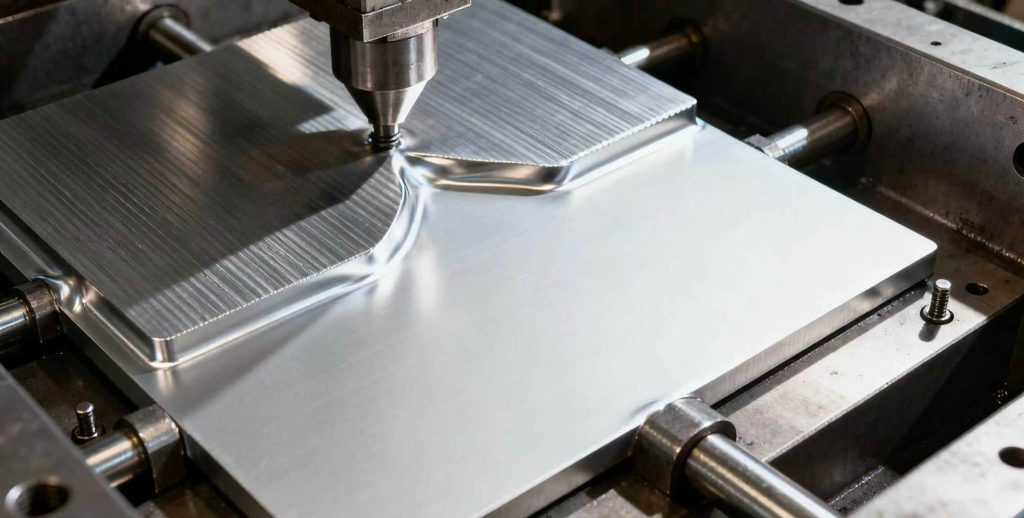
In high-load scenarios
For instance, when stamping metal parts for construction machinery, we use steel for the main structure and apply aluminum to auxiliary components in non-force-bearing parts. A specific example is that we pair load-bearing brackets with aluminum alloy stamped housing parts. This combination leverages the load-bearing advantages of steel while reducing overall weight through aluminum. In precision metal stamping, this steel-aluminum matching requires precise mold design. The design is mainly used to control the fit between the two materials and avoid stress concentration. And this precise control of mold design is exactly a key technical point of custom precision metal stamping services.
In fields with prominent lightweight needs
In new energy vehicle battery casing stamping, aluminum’s proportion increases significantly. Steel reinforces key stress points.
Through custom metal stamping, aluminum alloy sheets become casings with complex cavities. High-strength cold-rolled steel sheets are embedded in impact-prone areas. This forms a “aluminum-based, steel-supplemented” composite structure.
This scheme meets EV metal part stamping’s lightweight needs. It also ensures battery packs’ structural safety. It shows precision metal stamping’s precise control of material properties.
In precision metal stamping for the electronics industry
The matching of steel and aluminum focuses more on balancing conductivity and structural strength. For example, in connector stampings, stainless steel is used as the base of contact terminals, and aluminum foil is compounded on the surface to optimize conductivity. This matching allows precision metal stamping parts to meet both mechanical and electrical performance requirements, serving as a typical example of custom metal stamping for high-precision applications.
III. Process Optimization for Custom Metal Stamping: Achieving “1+1>2” with Steel and Aluminum
To integrate steel and aluminum well in custom metal stamping, two things are needed. Scientific matching strategies are essential. Continuous precision metal stamping process optimization is even more critical.
Mold design, stamping parameter adjustment and surface treatment all matter. Each link affects the two materials’ bonding effect. This determines the final quality of metal stamping manufacturing.
Mold Design Optimization
Mold design must account for steel and aluminum’s hardness difference. We need to set different edge angles and gaps.
Steel has high hardness. So mold edges need stronger wear resistance. Gaps are controlled at 5%-8% of material thickness.
Aluminum has good ductility. Edge gaps can be reduced to 3%-5%. This avoids burrs.
This refined design is what makes precision metal stamping different from ordinary stamping. It follows the “process adaptability” principle in How to Choose a Precision Sheet Metal Factory? Key Points Are Here
For composite stampings, molds must handle springback differences. Pre-deformation design offsets stress. This ensures precision metal stamping parts’ dimensional accuracy.
Stamping Parameter Adjustment
Dynamic adjustment of stamping parameters is crucial. Steel stamping needs higher pressure and slower speed. This ensures full forming.
Aluminum can use faster stamping speeds. This improves efficiency. It also prevents material cracking from excessive pressure.
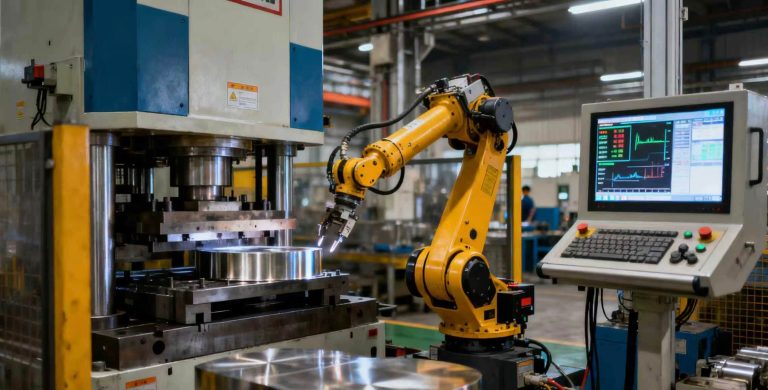
Most modern metal stamping manufacturers have intelligent control systems. These systems adjust parameters in real-time based on material combinations. This makes precision metal stamping more stable and efficient.
Surface Treatment Enhancement
Surface treatment improves material matching reliability. For example, we galvanize steel for rust prevention, and we anodize aluminum.
These treatments boost corrosion resistance. They also create better conditions for connecting the two materials. Welding and riveting are made easier.
Collaboration with Machining
The collaboration between precision metal stamping and precision metal machining expands possibilities. For complex custom metal stamping parts, stamping completes preliminary forming. Machining then adds precision.
This retains both materials’ advantages. It also meets higher precision requirements. This aligns with the core view in Collaboration between Precision Metal Machining and Stamping
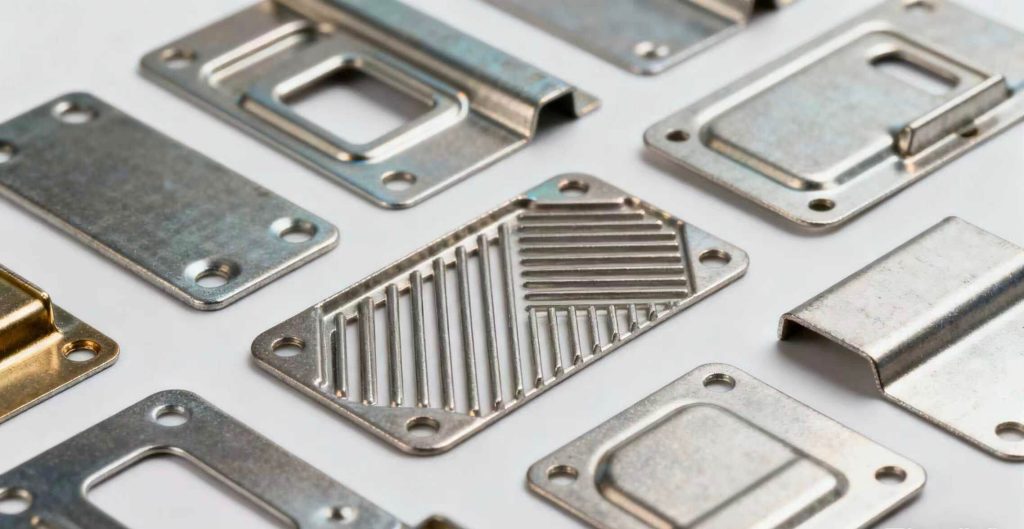
IV. Typical Application Scenarios: Practical Value of Steel-Aluminum Matching
In custom metal stamping needs across different industries, steel-aluminum matching schemes exhibit diverse characteristics, but their core logic remains “matching material properties to usage needs.” This logic drives continuous innovation in enterprises such as precision metal products private limited.
New Energy Vehicles: Lightweight & Safety
In the automotive industry, especially the new energy vehicle sector, the dual requirements of lightweight and safety in EV metal part stamping have made steel-aluminum matching mainstream. Car body frames are formed by stamping high-strength steel to ensure collision safety; parts such as doors and hoods are stamped from aluminum alloy to reduce overall vehicle weight. In the custom metal stamping process, laser welding technology achieves seamless connection between the two materials, meeting both the precision requirements of precision metal stamping and improving the overall performance of the car body. Statistics show that new energy vehicles adopting this scheme can reduce body weight by 15%-20% and increase battery range by over 10%, fully demonstrating the economic value of material matching.
Electronic Communication: Miniaturization & Heat Dissipation
Precision metal stamping parts in the electronic communication industry focus more on miniaturization and thermal conductivity. For example, when custom-stamping metal middle frames for mobile phones, we use stainless steel as the main frame body to ensure structural strength and drop resistance; we also stamp internal heat sinks from aluminum alloy to quickly dissipate heat generated by chips. This “steel-aluminum” combination achieves precision forming through micro-stamping technology in precision metal stamping, with part dimensional tolerances controlled within ±0.01mm, meeting the miniaturization needs of electronic devices. Meanwhile, the application of aluminum alloy heat sinks reduces device operating temperature by 5-8℃, improving product stability and service life.
Industrial Equipment: Corrosion Resistance & Load-Bearing
In the industrial equipment field, metal stamping manufacturing has high requirements for material corrosion resistance and load-bearing capacity. For example, when stamping accessories for chemical equipment, we use galvanized steel as the main structure to resist erosion from chemical media; we also stamp connecting parts from aluminum alloy to reduce the overall weight of the equipment. In the custom metal stamping process, surface passivation treatment further enhances corrosion resistance, extending the service life of stamping metal parts in harsh environments to 5-8 years—far longer than that of single-material parts. Additionally, as mentioned in the article Custom metal stamping for high-precision: Tackling the challenges in EV metal part stamping, reasonable material matching can significantly reduce equipment maintenance costs, an advantage that is particularly prominent in industrial scenarios.
V. Quality Control in Custom Metal Stamping: Core Quality Management After Material Matching
Steel-aluminum matching brings performance advantages to custom metal stamping. But it also raises higher quality control challenges.
In precision metal stamping, a full-process quality control system is a must. No links can be ignored—from material incoming inspection to finished product delivery. This is a core requirement of precise metal production.
Incoming Material Inspection
Incoming material inspection is the first defense. For steel, we need to conduct three key tests: tensile strength, yield strength, and elongation. This ensures it meets precision metal stamping forming needs.
For aluminum, key inspections focus on purity, hardness and surface quality. This prevents stamping cracking from excessive impurities.
Batch stability of both materials must be verified. This avoids material property fluctuations. It ensures stamped metal parts’ consistency.
Many precision metal manufacturing inc companies use precision equipment. Spectrometers, for example, enable rapid material property detection.
In-Process Online Inspection
Online inspection during stamping is critical. Visual inspection systems monitor two key points. They check metal parts stamping’s dimensional accuracy and surface defects.
Stamping parameters are adjusted promptly. This prevents mass production of defective products.
For composite stampings, connection strength needs testing. Tensile tests and fatigue tests are used. This ensures connection parts’ reliability.
As emphasized in Three Key Quality Control Points in Precise Metal Production, process quality control cuts costs. This is especially important for steel-aluminum custom metal stamping.
Finished Product Inspection
Comprehensive inspection before delivery is the final guarantee. Conventional dimensional and appearance inspections are done first.
Special tests are added based on application scenarios. For example, automotive components need impact resistance tests. Electronic components need conductivity tests.
Environmental resistance of precision metal stamping parts is verified. They must perform stably under harsh conditions. These include high/low temperatures, humidity and corrosion.
Full-process quality control maximizes steel-aluminum matching advantages. It provides customers with high-quality custom precision metal stamping services.
VI. Conclusion: Driving the Future Development of Custom Metal Stamping Through Material Innovation
Steel-aluminum flexible matching not only solves many technical problems in custom metal stamping but also effectively drives the upgrade of the precision metal stamping industry.
Meanwhile, as the new energy, electronics, and automotive industries grow rapidly, market demands are constantly changing—precision metal stamping parts now require more diverse and sophisticated designs.
In response to these changes, steel-aluminum matching schemes will continue to innovate. For instance, composite material technology can further enhance product performance, while combining with precision sheet metal fabrication enables the realization of more complex structural designs.
In this evolving landscape, metal stamping manufacturers must proactively take action: they need to continuously improve their process capabilities, deepen their understanding of material properties, and ultimately provide more precise and tailored custom metal stamping services.
If you are in need of professional custom precision metal stamping services, contact Vanmodel Sheet Metal today. We can help you find the optimal steel-aluminum matching scheme, and with our rich industry experience and advanced technical capabilities, we are committed to delivering high-quality precision metal stamping solutions that meet your specific needs.